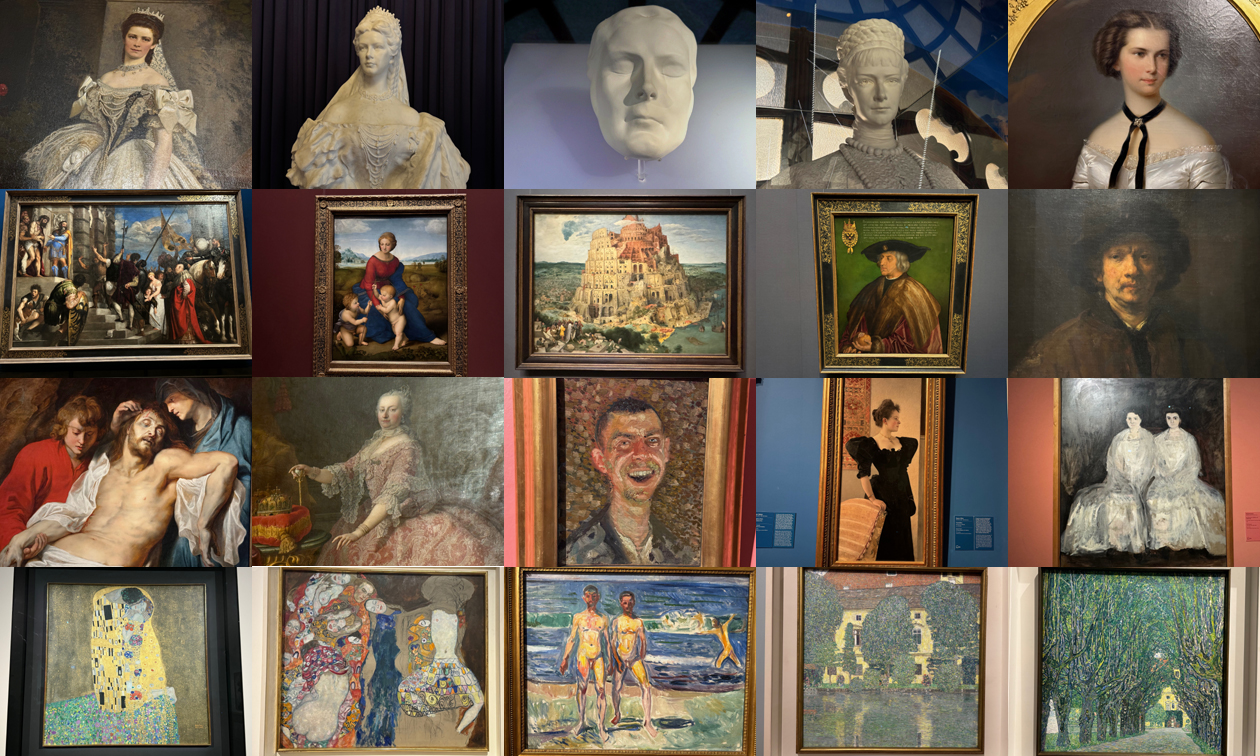
First Row:
1-5) Duchess Elisabeth Amalie Eugenie in Bavaria; December 24,1837 - September 10, 1898), nicknamed Sisi or Sissi, was Empress of Austria and Queen of Hungary from her marriage to Emperor Franz Joseph I on April 24, 1854 until her assassination in 1898. Elisabeth was born into the Ducal royal branch of the Bavarian House of Wittelsbach but enjoyed an informal upbringing before marrying her first cousin, Emperor Franz Joseph I, at 16. The marriage thrust her into the much more formal Habsburg court life, for which she was unprepared and which she found suffocating. She came to develop a deep kinship with Hungary and helped to bring about the dual monarchy of Austria-Hungary in 1867
Second Row:
1) Tizian "Ecce Homo," 1543. Jesus is on the left side of the composition. The excited young man to the left, acts as the compositional introduction while the view of the soldier's back leads our gaze up to the protagonist.
2) Raffael "The Madonna of the Meadow," 1505. The group formed into a pyramid is embedded in a delightful pasture landscape which on the one hand emphasizes the world of humans; yet in the way it fades out into the far-off horizon, it appears to accentuate what is eternally valid. Thus "The Madonna in the Meadow" became the icon of the new spiritual thinking of the Renaissance.
3) Pieter Bruegel, "The Tower of Babel," 1563. Bruegel's monumental composition became the most famous, most often copied and varied classic depiction of the tower. Bruegel depicts countless technical and craftsmanship processes. He blends elements from antique and Romanesque architecture in the stone structure around the building's exterior.
4) Albrecht Durer "Emperor Maximilian," 1519. The emperor is depicted here as an elegant private gentleman. The desired effect of dignity and power is achieved by the manner in which the emperor fills the frame and the brilliant execution of the fur collar. Several different interpretations have been suggested for the pomegranate in the emperor's hand: as a private proxy for the imperial orb; as a reference to the Persephone and thus a reference to death; and as an allusion to the conquest of Granada by the Christian armies in 1492.
5) Rembrandt Harmensz van Rijn "Large Self-Portrait," 1652. This self portrait has special significance among Rembrandt's works. In all, the artist painted more than sixty self-portraits, thus documenting not only the conditions of his life but, also and in particular, his artistic development. In a manner different from that of his early successful years, when the artist portrayed himself disguised or in splendid clothing, here we see him in a simple brown artist’s smock in a confident posture, his hands on his hips and his thumbs in his belt.
Third Row:
1) Peter Paul Rubens "Lamentation of Christ by the Virgin Mary and John," 1615. In the late Middle Ages a number of pictorial types developed from the series of paintings depicting the Passion of Christ. They served as devotional images for personal piety. Here, the individual phases of the Passion - the crowning with thorns, the crucifixion, lamentation and entombment - are made comprehensible in a single painting.
2) Maria Theresa (Maria Theresia Walburga Amalia Christina; May 13, 1717 - November 29,1780) was ruler of the Habsburg dominions from 1740 until her death in 1780. She was the sovereign of Austria, Hungary, Croatia, Bohemia, Transylvania, Mantua, Milan, Galicia and Lodomeria, the Austrian Netherlands, and Parma. Maria Theresa started her 40-year reign when her father, Emperor Charles VI, died on October 20, 1740. Frederick II of Prussia (who became Maria Theresa's greatest rival for most of her reign) promptly invaded and took the affluent Habsburg province of Silesia in the eight-year conflict known as the War of the Austrian Succession. In defiance of the grave situation, she managed to secure the vital support of the Hungarians for the war effort. During the course of the war, Maria Theresa successfully defended her rule over most of the Habsburg monarchy, apart from the loss of Silesia and a few minor territories in Italy. Maria Theresa later unsuccessfully tried to recover Silesia during the Seven Years' War. She promulgated institutional, financial, medical, and educational reforms. She also promoted commerce and the development of agriculture, and reorganized Austria's ramshackle military, all of which strengthened Austria's international standing. A pious Catholic, she despised Jews and Protestants, and on certain occasions she ordered their expulsion to remote parts of the realm. She also advocated for the state church.
3) Richard Gerstl "Self-Portrait, Laughing," 1908
4) Gustav Klimt "Portrait of a Woman," 1894. The artist worked in this highly realistic style in the years around 1980 in a way that reeals the influence of photography. He would alsouse photography to help compose his later paintings. It is Klimt's first society portrait of a woman. After Hans Makart's death, Klimt became the most sought-after portraitist of the Viennese upper class.
5) Richard Gerstl "The Sisters Karoline and Pauline Fey," 1907
Fourth Row:
1) Gustav Klimt "The Kiss (Lovers)," 1909. The Kiss, probably Klimt's most famous work, was painted at the height of his Golden Period without a direct commission. It shows a couple, melting into one, at the edge of a meadow of flowers. On the different patterning of the robes distinguishes their bodies that are enveloped in a shimmering gold halo. Klimt actually used real old leaf, silver, and platinum in his picture. He presumably started work on it in 1907 and exhibited the painting at the Kunstschau in June the following year under the title "Lovers."
2) Gustav Klimt "Bride," 1918 Gustav Klimt painted "The Bride" in the last year and a half of his life. When Klimt died on February 6, 1918 following a stroke, this colorful work was discovered unfinished on the easel in his studio. It clearly demonstrates Klimt's working methods. In places, the sketchy preliminary drawing is still visible, whereas some of the motifs appear finished. At the center of the painting, a young woman rests her head on a man's shoulder. Her eyes are closed; her body is completely enveloped. Around her, naked women are writing in erotic ecstasy. In this large allegorical work about the relationship between man and woman, Klimt explores his concept of male desire one last time.
3) Edvard Munch "Men on the Seashore," 1944 For the first time in 1907, the Norwegian artist focused his attention on the naked male body. The following year, he painted two men on the beach in a frontal pose.
4) Gustav Klimt "Schloss Kammer on Lake Attersee," 1909
5) Gustav Klimt "Avenue to Schloss Kammer," 1912
. . . . A word about Gustav Klimt . . . .
Gustav Klimt not only shaped the genre of portraiture, but he also introduced radical innovations in the depiction of landscape and nature. The artist found most of his landscape motifs during his annual summer sojourns at the Attersee lake in the Salzkammergut. In a virtually square format, often without sky or horizon, he channels our gaze toward a confined section of landscape. Occasionally Klimt even used a telescope to zoom up close to these passages. His landscapes do not unfurl into the distance but emplazize the picture's surface. This enhances the effect of a flat decorative pattern, further accentuated by a painting technique that drew inspiration from Pointillism. Klimt placed his brushstrokes in precise juxtaposition. The overall effect prompted art critic Ludwig Hevesi to aptly describe this images as "painted mosaics."