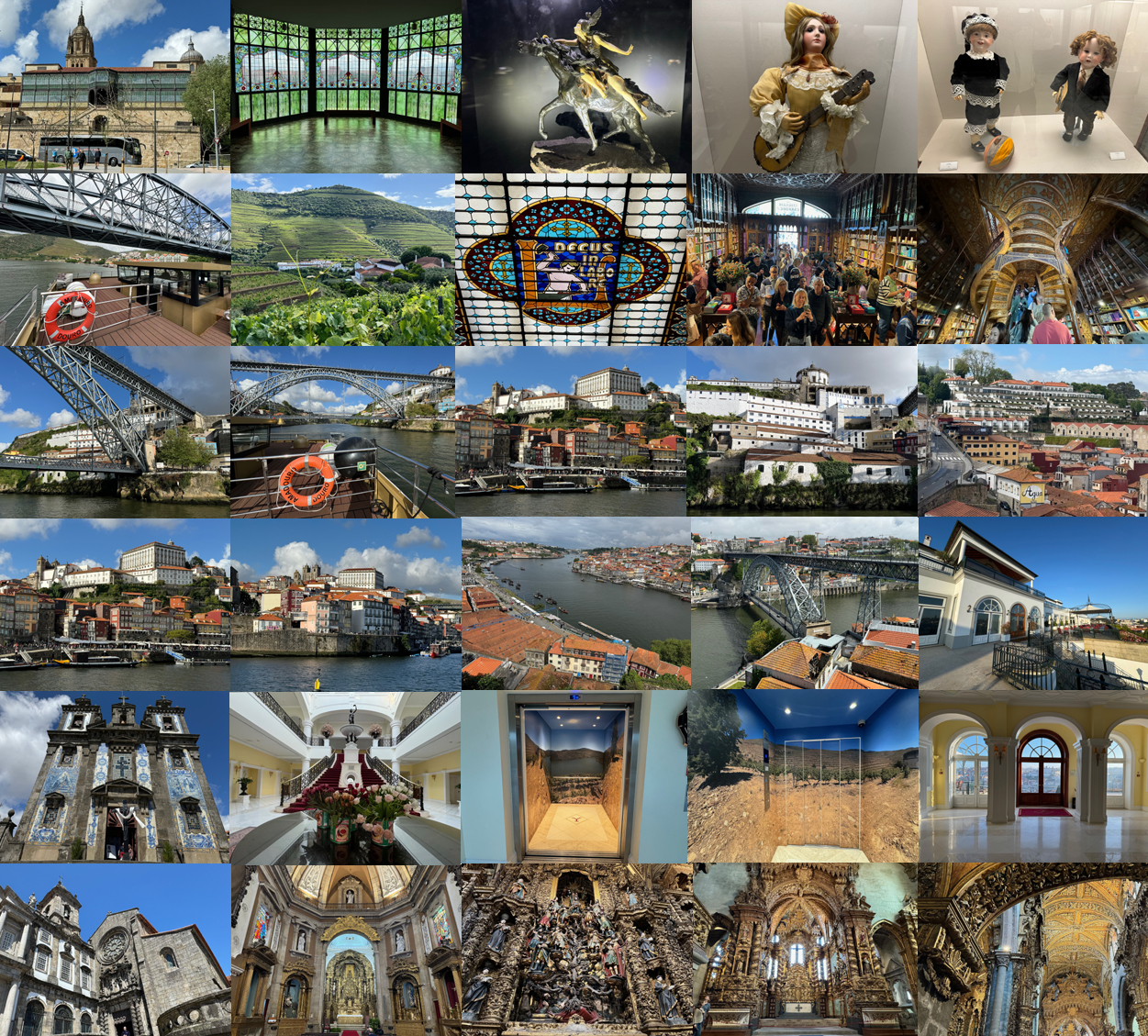
Art Deco, Salamanca and Port
The Art Deco museum in Salamanca, also known as Museo Art Nouveau y Art Deco, Casa Lis is a museum located in the ancient city wall of Salamanca, Spain and known for its exhibits dating from the last decades of the 19th century to World War II.
To see hundreds of magnificent Art Deco treasures of the world, please visit:
https://images.search.yahoo.com/search/images;_ylt=Awr9DuDSSs5cED0APcZXNyoA;_ylu=X3oDMTByNWU4cGh1BGNvbG8DZ3ExBHBvcwMxBHZ0aWQDBHNlYwNzYw--?p=Museo+Art+Nouveau+and+Art+D%C3%A9co%2C&fr=yhs-invalid#id=197&iurl=https%3A%2F%2Fc1.staticflickr.com%2F3%2F2342%2F1859381790_31ee4276d5_z.jpg%3Fzz%3D1&action=click
The Art Nouveau and Art Deco Museum is essentially a museum for decorative arts that sets a sweeping tour through time from the last decades of the 19th century until World War II. This period of time of no more than sixty years is certainly one of the most prolific of the applied arts. The bulk of the pieces that can be seen at the Museum are utilitarian objects which respond to meticulous aesthetic criteria. This is the duality that, on the one hand, makes them really interesting as a testimony of the way of life at that time and that, on the other hand, made some of them disappear due to their daily use.
During the 19th century, the decorative arts remained stuck in the past, characterized by the systematic repetition of patterns and by the increasingly poorer quality finishes due to a lack of traditional character. The machines had imposed production systems that gave priority to quantity over quality. This situation led to a reaction, making the Arts & Crafts artists seek new models of expression and new ways of creativity, and advocating for the comparison of the decorative arts and the Fine Arts, so that more attention was paid to the quality and detail and the exquisite finishes. This aesthetic concern was the birth of a new style: the Art Nouveau.
Throughout its nineteen collections, the sweeping tour shows the visitor the production of the European workshops of decorative arts during the Nouveau an Deco periods: jewellery by Masriera and Faberge; iridescent glass from the workshops of Lotz, Kralik, Pallme Konig or l'Ecole de Nancy, including pieces by Emile Galle, the Daum brothers and Paul Nicolas; furniture by Homar, Majorelle, Busquets; porcelain pieces by Rosenthal, Royal Copenhagen, Mariano Benlliure, Gustave Guetant and Zuloaga. The funds amassed by the Lis House show the professional trajectory of very significant artists such as Emile Galle and his glass works of superimposed layers and his exquisite furniture, or the evolution of Rene Lalique who, starting out by designing Art Nouveau jewellery, subsequently orientated his creativity towards glass design in the following decades. The French porcelain doll collection from the 19th century is outstanding and has been defined by experts as the best collection ever exhibited worldwide, as well as the Chryselephantine collection by Demetre Chiparus or Ferdinand Preiss, small sculptures that combine metal for clothes and ivory for the nude parts of the body such as hands and face, that have become emblematic of Art Deco.
Livraria Lello
www.livrarialello.pt The Livraria Lello & Irmao, (Lello Bookshop), is rated among the most beautiful bookstores in the world, built in the Neo-Manueline style. The Livraria Lello & Irmao, commonly known in English as the Lello Bookshop, is a bookshop located in Porto. Along with Bertrand in Lisbon, it is one of the oldest bookstores in Portugal.
The Yeatman Hotel
THE place to stay for the discerning luxury traveler.
This luxury hotel, which opened in 2010, features 89 beautifully decorated rooms and 20 suites, all of which boast terraces and balconies with panoramic views over the city, which is just a short walk away.
Located high on the south bank of the River Douro in the historic heart of Vila Nova de Gaia, the hotel is surrounded by ancient Port lodges where Port houses such as Taylor Fladgate have stored there Port wine for over three centuries.
The Yeatman, widely regarded as the best hotel in Porto, blends timeless elegance and a wealth of authentic detail to create a very special atmosphere which evokes the distinctive personality of this ancient city and its historic link to the world of wine.
The hotel has established partnerships with many of Portugal's finest wine producers, such as Taylor Fladgate, who actively participate in The Yeatman's program of tastings, seminars and wine dinners. These partner wineries also sponsor individual rooms and suites which feature intriguing pictures and objects to provide an insight into each winery's unique history and environment, adding a discreet individual accent to each guest room.
Complementing The Yeatman's own wine activities, visits can be arranged to leading vineyards and estates in the Douro Valley, Minho, Dao and Bairrada wine regions, all easily accessible by road.
This wine hotel's luxury spa has a large indoor pool and hot tub offering panoramic views of Oporto. Each bright room of the 5-star The Yeatman hotel opens onto a spacious, private terrace furnished with sun loungers. Stylish, dark wood headboards and elegant ottomans are among the chic furnishings fitted in each of The Yeatman's luxurious rooms. Rooms also include a flat-screen TV and mini-bar. Bathrooms are equipped with luxurious skincare products from the Caudalie skincare range. The 2-Michelin awarded Yeatman Restaurant serves Portuguese cuisine made with fresh, local produce and fine wines. Specialty Portuguese wines can be enjoyed every Thursday during the wine tasting. Cushioned seating areas are set around the outdoor pool which overlooks the Douro River. The contemporary, well-equipped gym offers state-of-the-art cardiovascular equipment. Conveniently located in Vila Nova de Gaia, Yeatman hotel is only a 5-minute walk from General Torres Station and a 10-minute walk from the Douro River. Sa Carneiro International Airport is 11 mi from the property.
The Yeatman Hotel is a 5.0 star Luxury hotel with full-service spa, connected to a shopping center, near Taylor's Port Cellars - Rating - 9.6/10 - Exceptional ~ including a gym, pool, hot tub, and airport transfers.
Clerigos Church and Tower (Torre & Igreja dos Clerigos)
Standing atop a hill overlooking Porto, Portugal, are the Igreja dos Clerigos, an 18th-century church and one of the city's architectural symbols, and the Toree dos Clerigos, its bell tower. Intricately carved baroque shells and garlands on the church reflect Porto's seaside location, and the bell tower offers panoramic views of the city.
The church was built for the Brotherhood of the Clerigos (Clergy) by Nicolau Nasoni, an Italian architect and painter who left an extensive body of work in the north of Portugal during the 18th century.
Construction of the church began in 1732 and was finished in 1750, while the bell tower and the monumental divided stairway in front of the church were completed in 1763. The main facade of the church is heavily decorated with baroque motifs, (such as garlands and shells). This was based on an early 17th-century Roman scheme. The central frieze above the windows present symbols of worship and an incense boat. The lateral facades reveal the almost elliptic floorplan of the church nave.
The Clerigos Church was one of the first baroque churches in Portugal to adopt a typical baroque elliptic floorplan. The altarpiece of the main chapel, made of polychromed marble, was executed by Manuel dos Santos Porto.
The monumental tower of the church, located at the back of the building, was only built between 1754 and 1763. The baroque decoration here also shows influence from the Roman Baroque, while the whole design was inspired by Tuscan campaniles. The tower is 75.6 metres high, dominating the city. There are 240 steps to be climbed to reach the top of its six floors. This great structure has become the symbol of the city.
In Porto, Nicolau Nasoni was also responsible for the construction of the Misericorida Church, the Archbishop's Palace and the lateral loggia of Porto Cathedral. He entered the Clerigos Brotherhood and was buried, at his request, in the crypt of the Clerigos Church, with the exact place remaining unknown.
In June 2015, the Clerigos Brotherhood announced that after 250 years, the Clerigos Tower and Church will open its doors during nighttime hours.
Church of Sao Francisco (Igreja de Sao Francisco)
Behind its comparatively stark Gothic facade, the Church of Sao Francisco (Igreja de Sao Francisco) harbors a trove of baroque finery: The interior has marble columns, intricate wooden carvings, and gold-covered walls. Highlights include the magnificent Tree of Jesse altarpiece, a 13th-century statue of Saint Francis, and eerily beautiful catacombs.
Giovanni di Pietro di Bernardone: (c.1181 - 3 October 1226), known as "Francis of Assisi," was an Italian mystic, poet and Catholic friar who founded the religious order of the Franciscans. He was inspired to lead a Christian life of poverty as a beggar and itinerant preacher. One of the most venerated figures in Christianity, Francis was canonized by Pope Gregory IX on 16 July 1228. He is commonly portrayed wearing a brown habit with a rope tied around his waist, featuring three knots that symbolize the three Franciscan vows of poverty, chastity, and obedience.
In 1219, he went to Egypt in an attempt to convert the sultan al-Kamil and put an end to the conflict of the Fifth Crusade. In 1223, he arranged for the first live nativity scene as part of the annual Christmas celebration in Greccio. According to Christian tradition, in 1224 Francis received the stigmata during the apparition of a Seraphic angel in a religious ecstasy.
He founded the men's Order of Friars Minor, the women's Order of St. Clare, the Third Order of St. Francis and the Custody of the Holy Land. Once his community was authorized by Pope Innocent III, he withdrew increasingly from external affairs.
Francis is associated with patronage of animals and the environment. It became customary for churches to hold ceremonies blessing animals on his feast day of the fourth of October. He is known for devotion to the Eucharist. Along with Catherine of Siena, he was designated patron saint of Italy. He is also the namesake of the American city of San Francisco.
Port Wine
Port wine (Portuguese: vinho do Porto, Portuguese: 'wine of Porto', or simply port, is a Portuguese fortified wine produced in the Douro Valley of northern Portugal. It is typically a sweet red wine, often served with dessert, although it also comes in dry, semi-dry, and white varieties.
Port wine is typically richer, sweeter, heavier, and higher in alcohol content than unfortified wines. This is caused by the addition of distilled grape spirits that fortify the wine, but also halt fermentation before all the sugar is converted to alcohol, and results in a wine that is usually 19% to 20% alcohol.
Port is commonly served after meals as a dessert wine in English-speaking countries, often with cheese, nuts, or chocolate; white and tawny ports are often served as an aperitif. In Europe, all types of ports are frequently consumed as aperitifs.
Styles
Port from Portugal comes in several styles, which can be divided into two broad categories: wines matured in sealed glass bottles, and wines that have matured in wooden barrels.
The former, without exposure to air, experience what is known as "reductive" ageing. This process leads to the wine losing its color very slowly and produces a wine that is smoother on the palate and less tannic.
The latter, being matured in wooden barrels, whose permeability allows a small amount of exposure to oxygen, experience what is known as "oxidative" aging. They too lose color, but at a faster pace. They also lose volume to evaporation (angel's share), leaving behind a wine that is slightly more viscous.
The IVDP (Instituto dos Vinhos do Douro e Porto) further divides ports into two categories: normal ports (standard ruby, three-year-old tawny, and white) and Categorias Especiais, special categories, which include everything else.
Ruby
The most common type, ruby port is stored in tanks of concrete or stainless steel after fermentation, to prevent oxidative aging and preserve its bright red color and full-bodied fruitiness. The wine is usually blended to match the style of the brand to which it is to be sold. The wine is fined and cold filtered before bottling and does not generally improve with age, although premium rubies are aged in wood from four to six years.
Reserve
Reserve ruby is a premium ruby port approved by the IVDP's tasting panel, the Camara de Provadores. In 2002 the IVDP prohibited the use of the term "vintage character," as reserve ruby port had neither a single vintage (usually being a blend of several vintages of the ruby) nor the typical character of vintage port.
Rose
very recent variation on the market, first released in 2008 by Pocas and by Croft, part of the Taylor Fladgate Partnership. It is technically a ruby port, but fermented in a similar manner to a rose wine, with limited exposure to the grape skins, thus creating the rose color.
Tawny
Tawny ports are wines usually made from red grapes that are aged in wooden barrels exposing them to gradual oxidation and evaporation. As a result of this oxidation, they mellow to a golden-brown color. The exposure to oxygen imparts "nutty" flavours to the wine, which is blended to match the house style. They are sweet or medium dry and typically consumed as a dessert wine, but can also pair with a main course.
When a port is described as tawny, without an indication of age, it is a basic blend of wood-aged port that has spent time in wooden barrels, typically at least three years.
Reserve tawny port (produced by Borges, Calem, Croft, Cruz, Graham, Kopke, and other houses) has been aged about seven years.
Above this are tawny with an indication of age, which represent a blend of several vintages. The target age profile, in years in wood, is stated on the label, usually 10, 20, 30, or 40 years. These ports are produced by most houses.
It is also possible to produce an aged white port in this manner, with some shippers now marketing aged white ports.
In some places, such as Canada and Australia, 'tawny' may also be used to describe any port-style wine that is not produced in Portugal, in accordance with an agreement with the EU.
Colheita
Colheita port is a single-vintage tawny port aged for at least seven years, with the vintage year on the bottle instead of a category of age (10, 20, etc.). Colheita port should not be confused with a vintage port: a vintage port will spend only about 18 months in barrels after harvest and will continue to mature in bottles, but a Colheita may have spent 20 or more years in wooden barrels before being bottled and sold. White Colheitas have also been produced.
White Port
White port is made from white grapes, such as Malvasia
Fina, Donzelinho, Gouveio, Codega and Rabigato.
Taylor introduced Chip Dry, a new style of white aperitif Port, in 1934. Made from traditional white grape varieties, it is fermented for longer than usual to give it a crisp dry finish.
Late bottled vintage
Late bottled vintage (often referred to simply as LBV) was originally wine that had been destined for bottling as vintage port, but because of lack of demand was left in the barrel for longer than had been planned. Over time it has become two distinct styles of wine, both of them bottled between four and six years after the vintage, but one style is fined and filtered before bottling, while the other is not.
The accidental origin of late bottled vintage has led to more than one company claiming its invention. The earliest known reference to a style of port with this name in a merchant's list is to be found in The Wine Society's catalogue from 1964, which includes Fonseca's Quinta Milieu 1958, bottled in the UK, also in 1964. By the 1962 vintage, LBV was being produced in Portugal and bottled as LBV.
LBV is intended to provide some of the experience of drinking a vintage port but without the need for lengthy bottle ageing. To a limited extent, it succeeds, as the extra years of oxidative ageing in the barrel does mature the wine more quickly.
Unfiltered
Unfiltered LBVs are mostly bottled with conventional driven corks and need to be decanted. After decanting they should be consumed within a few days. Recent bottlings are identified by the label "unfiltered", "bottle matured", or both. Since the 2002 regulations, bottles that carry the words "bottle matured" must have enjoyed at least three years of bottle maturation before release. Before 2002 this style was often marketed as "traditional", a description that is no longer permitted. Unfiltered LBV will usually be improved by extra years in the bottle. It can age as long as vintage ports and are very difficult to identify as LBVs when inserted into blind tastings of vintage ports.
The filtered wine has the advantage of being ready to drink without decanting and is usually bottled in a stoppered bottle that can be easily resealed. However, many wine experts feel that this convenience comes at a price and believe that the filtration process strips out much of the character of the wine.
Typically ready to drink when released, filtered LBV ports tend to be lighter-bodied than vintage ports. Filtered LBVs can improve with age, but only to a limited degree.
Vintage Port
Vintage ports may be aged in barrels or stainless steel for a maximum of two and a half years before bottling, and generally require another 10 to 40 years of aging in the bottle before reaching what is considered a proper drinking age. Since they are potentially aged in a cask for only a short time, they retain their dark ruby color and fresh fruit flavors. Particularly fine vintage ports can continue to gain complexity for many decades after they were bottled. It is not uncommon for 19th-century bottles to still be in perfect condition for consumption. The oldest known vintage port still available as of 2018 from a shipper is the 1815 Ferreira. A tasting in 1990 described it as having an "intensely spicy aroma - cinnamon, pepper, and ginger - hints of exotic woods, iodine, and wax."
Vintage port is made entirely from the grapes of a declared vintage year. While it is by far the most renowned type of port, from a volume and revenue standpoint, vintage port accounts for only about two percent of overall port production. Not every year is declared a vintage in the Douro. The decision on whether to declare a vintage is made early in the second year following the harvest. The decision to declare a vintage is made by each individual port house often referred to as a "shipper."
Much of the complex character of aged vintage port comes from the continued slow decomposition of grape solids in each bottle. These solids are undesirable when the port is consumed, and thus vintage port typically requires a period of settling before decanting and pouring.
Single quinta vintage port Single quinta vintage ports are wines that originate from a single estate, unlike the standard bottlings of the port wine houses which can be sourced from a number of quintas. Single quinta bottlings are used in two ways by producers. Most of the large port wine houses have a single quinta bottling which is only produced in some years when the regular vintage port of the house is not declared. In those years, wine from their best quinta is still bottled under a vintage designation, rather than being used for simpler port qualities.
Vintages
The term vintage has a distinct meaning in the context of vintage port. While vintage is simply the year in which a wine is made, most producers of vintage port restrict their production of year-labelled bottlings to only the best years, a few per decade. Contrast with second wines, where (primarily) Bordeaux producers release a year-labelled top wine almost every year, but also lesser quality wines in some years.
If a port house decides that its wine is of a quality sufficient for a vintage, samples are sent to the IVDP for approval and the house declares the vintage. In very good years, almost all the port houses will declare their wines.
In intermediate years, the producers of blended vintage ports will not declare their flagship port but may declare the vintage of a single quinta, e.g., the 1996 Dow's Quinta do Bomfim and Taylor's Quinta de Vargellas. Some houses declare their wines in all but the worst years: Quinta do Vesuvio has declared a vintage every year with the exceptions of 1993, 2002, and 2014.
Improved wine-making technologies and better weather forecasts during the harvest have increased the number of years in which a vintage can be declared. Although there have been years when only one or two wines have been declared, it has been over thirty years since there was a year with no declarations at all.
2016 was declared a vintage year by most producers, as was 2011. The quality of the grape harvest was attributed to ideal rainfall and temperature. Other recent widely declared vintage years were 2007, 2003, 2000, 1997 and 1994.