From its origin in Spain, the Douro River flows into the Atlantic Ocean in Porto
You will enjoy seeing Portugal's rambling vineyards and charming farms called quintas - clinging to the steep hillsides - in the oldest demarcated wine region of the world! Known for its historic architecture, Lisbon echoes its wealth from the "Age of Discovery" when the Portuguese ruled the seas.
Lisbon
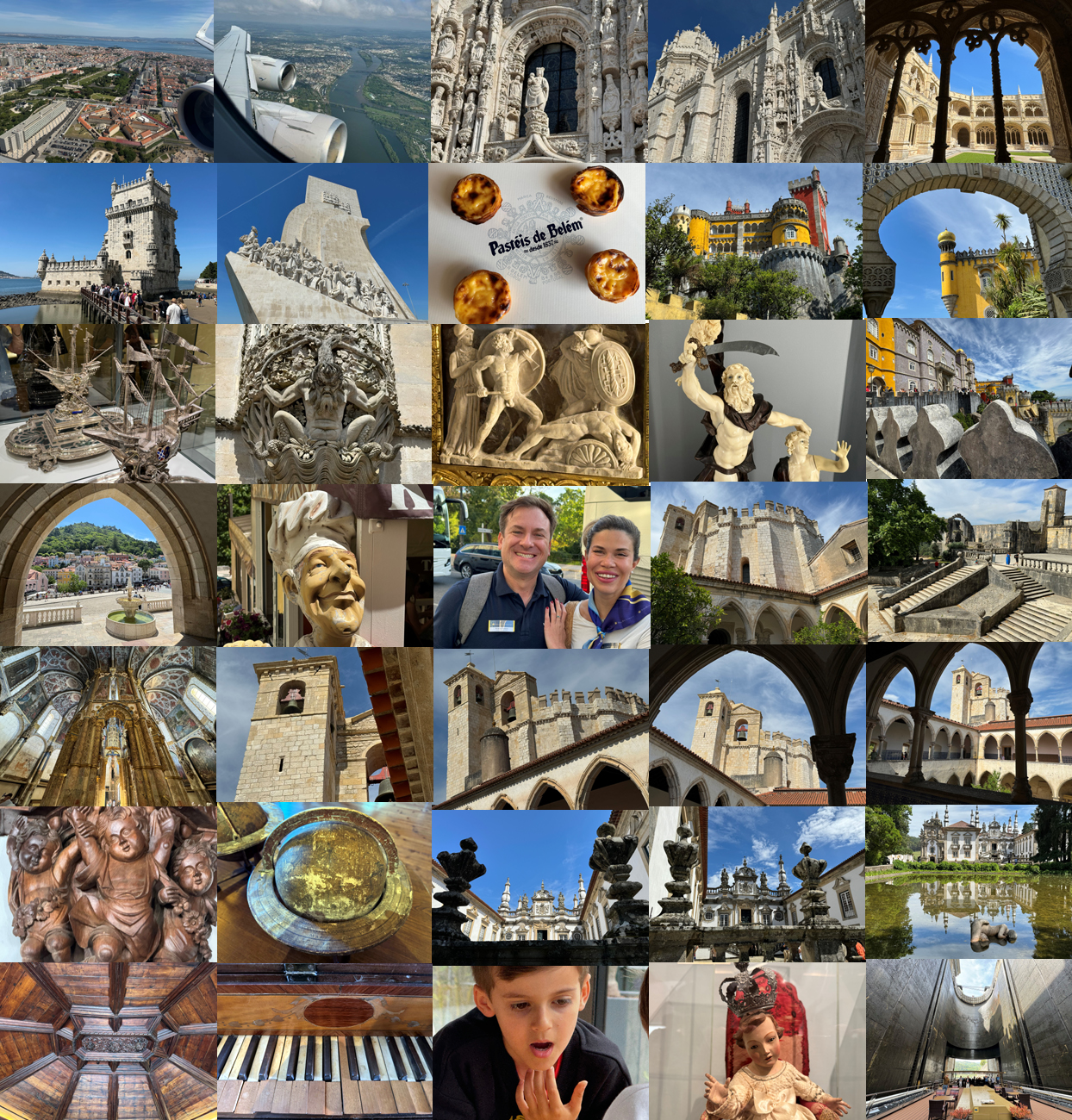
The iconic Belem Tower, (the name comes from Bethlehem), was built in the 16th century to guard the port. Lisbon has housed cannons, prisoners, and royalty over the centuries.
Nearby, you will enjoy one of the "ten most delicious desserts in Europe" - the original "pasteis de nata," at Pasteis de Belem which has been producing their famous and now ubiquitous cream custard tarts since 1837! Also, quite notable is Portugal's bica coffee. Bica is similar to espresso, but extracted to a greater volume than its Italian counterpart and a little bit smoother in taste, due to the Portuguese roasting process - slightly lighter than Italian espresso, but uniquely Portuguese.
Hieronymites Monastery, is a masterpiece of Manueline architecture. The Portuguese late Gothic style was named after King Manuel I. The monastery was erected during the 16th century, and was decorated with sculptures and elaborate scroll work.
Sintra
Serra de Sintra is one of the loveliest mountain villages in Portugal and a favorite summer residence of the Portuguese royal family for more than 500 years. Long an inspiration for artists and poets, Lord Byron once called it "perhaps the most delightful village in Europe." High up on a rocky peak, you will tour Pena National Palace, a wonderful fairytale castle dating back to Portugal's Romantic period.
Built on the spot of a ruined monastery (which, according to legend, occurred after an apparition of the Virgin Mary), the King's Castelo da Pena would become a UNESCO World Heritage Site, one of the Seven Wonders of Portugal and one of the most stunning examples of Romantic architectonic style. Many have called this a prototype of Germany's Neuschwanstein castle, which in turn inspired Disney's Cinderella Castle.
Also known as the Pena Palace or the Palacio da Pena, the castle is a colorful blend of styles in accordance with the taste of Romanticism. These include Neo-Gothic, Neo-Manueline, Neo-Islamic and Neo-Renaissance. Its extravagant exterior includes an enveloping wall, drawbridge, clock tower, the restored old convent from the Middle Ages, Moorish arches, gargoyles and a conglomeration of bastions, turrets, ramparts and domes.
Surrounding the palace is also a stunning garden - 200 hectares of forested walkways, beautiful vistas and hidden paths - with over 500 species of trees originating from the former colonies of the Portuguese empire. The garden is dotted with plenty of lovely fountains, statues, pergolas, grottoes, bridges and ponds.
Inside, find a spacious ballroom, 16th century altarpiece, delicately carved ceilings and walls, antiques and exotic woodwork.
The Mateus Palace is on the label of every
(uniquely narrow-necked,
flask-shaped bottles)
of sweet, frizzante rose wine
The Mateus Palace was built for the Third Morgado of Mateus, Antonio Jose Botelho Mourao, and is located just outside of the pretty city of Vila Real (which translates to Royal Town as it was founded by King Denis of Portugal and was popular among members of the royal family during the Middle Ages). It was designed by famed architect and artist Nicolau Nasoni from 1739-1743. An Italian, he spent most of his adult life in Porto and created many of his most celebrated works there. Porto's Sao Pedro dos Clerigos Church and Granite Tower are considered to be among his greatest works – but he also designed numerous other buildings and façades when he was approached to design the palace.
The Mateus Palace was built for the Third Morgado of Mateus, Antonio Jose Botelho Mourao, and is located just outside of the pretty city of Vila Real (which translates to Royal Town as it was founded by King Denis of Portugal and was popular among members of the royal family during the Middle Ages). It was designed by famed architect and artist Nicolau Nasoni from 1739-1743. An Italian, he spent most of his adult life in Porto and created many of his most celebrated works there. Porto's Sao Pedro dos Clerigos Church and Granite Tower are considered to be among his greatest works – but he also designed numerous other buildings and façades when he was approached to design the palace.
A stunning Baroque masterpiece, the palace is a lavish in its every detail. Elegantly formal flowerbeds are mazelike in appearance, rivaling those of many other palaces throughout Europe. Enjoy the box hedges, various statues, cedar tunnel (roughly 115 feet long) and the pond on the grounds. The roof is decorated with beautiful pinnacles and ornate balustraded stairways grace the exterior of the palace.
Inside is just as stunning - with intricately carved wood ceilings and dark chestnut wooden floors, elegant furniture and rugs from several different time periods, valuable paintings from the 17th and 18th centuries, Chinese porcelain, Portuguese china and silverware, ceramics and an impressive library.
Notably a small vineyard and winery is also here - but instead of Mateus wine, they make Port wine on the palace grounds. You can also purchase Port wine - but not Mateus wine - in a gift shop. This is because despite the Palace gracing the label, and thereby seeming synonymous with the rose, it actually has very little to do with the famous varietal itself.
Once one of the world's most popular wines, Mateus was created in 1942 and was all the rage in the 1970s. Queen Elizabeth requested it. Jimi Hendrix was photographed drinking it out of a bottle. Elton John sang about it in his 1973 song 'Social Disease.' It even made an appearance in the classic film, Animal House (in the home of Professor Dave Jennings, as played by Donald Sutherland).
Medium light pink, slightly fizzy with good freshness and balance and a nice floral aroma, Mateus offers a slightly watermelon, dried raspberry taste. A blend of about 10 different red grape varieties (all native to the Douro region) go into the wine - including Baga, Rufete, Tinta Barroca and Touriga Franca grapes.
Church of Sao Francisco (Igreja de Sao Francisco)
Behind its comparatively stark Gothic facade, the Church of Sao Francisco (Igreja de Sao Francisco) harbors a trove of baroque finery: The interior has marble columns, intricate wooden carvings, and gold-covered walls. Highlights include the magnificent Tree of Jesse altarpiece, a 13th-century statue of Saint Francis, and eerily beautiful catacombs.
Giovanni di Pietro di Bernardone: (c.1181 - 3 October 1226), known as "Francis of Assisi," was an Italian mystic, poet and Catholic friar who founded the religious order of the Franciscans. He was inspired to lead a Christian life of poverty as a beggar and itinerant preacher. One of the most venerated figures in Christianity, Francis was canonized by Pope Gregory IX on 16 July 1228. He is commonly portrayed wearing a brown habit with a rope tied around his waist, featuring three knots that symbolize the three Franciscan vows of poverty, chastity, and obedience.
In 1219, he went to Egypt in an attempt to convert the sultan al-Kamil and put an end to the conflict of the Fifth Crusade. In 1223, he arranged for the first live nativity scene as part of the annual Christmas celebration in Greccio. According to Christian tradition, in 1224 Francis received the stigmata during the apparition of a Seraphic angel in a religious ecstasy.
He founded the men's Order of Friars Minor, the women's Order of St. Clare, the Third Order of St. Francis and the Custody of the Holy Land. Once his community was authorized by Pope Innocent III, he withdrew increasingly from external affairs.
Francis is associated with patronage of animals and the environment. It became customary for churches to hold ceremonies blessing animals on his feast day of the fourth of October. He is known for devotion to the Eucharist. Along with Catherine of Siena, he was designated patron saint of Italy. He is also the namesake of the American city of San Francisco.
Cork: A Look at One of Portugal's Biggest Industries
Written by: James Cave, Author of Moving to Portugal Made Simple
December 20, 2023
If you've spent any time in Portugal recently, you've probably stumbled across a gift shop selling all kinds of products made from cork including shoes, handbags, and wallets.
Cork is one of Portugal's biggest and most important exports. In fact, Portugal is the biggest cork producer in the world and produces more than 50% of the world's cork supply. The vast majority of this is made into wine bottle stoppers but, increasingly, more and more cork is being sold to the construction and fashion industries and even to the space industry.
Cork is such a big industry that Portugal's richest family and a frequent name on the Forbes Rich List, The Amorim family, made its multi billion dollar fortune in cork, although now their portfolio includes investments in other industries.
As well as being ideal for storing wine, cork is excellent for sound and heat insulation, and it's increasingly being used for sound-proofing materials and for floor tiles.
It's also used for all kinds of accessories including handbags, purses, wallets, mousemats, yoga mats, iPad covers, shoes, furniture, as well as in woodwind instruments, and inside baseballs.
The best thing about cork is that it's sustainable. The trees aren't cut down or damaged when the cork is harvested, and, they can be harvested every 9 years for the lifetime of the tree (roughly 270 years). To cut down a cork tree you actually need a permit from the Portuguese Ministry of Agriculture. It's illegal to cut a cork tree down without one.
Cork-made products like handbags, briefcases, and belts are vegan-friendly as well, as normally these products would be made from leather.
The Business of Cork
It takes 25 years from planting a cork oak tree (Quercus suber) until the tree is ready for its first harvest.
That first harvest, which is known as virgin cork, isn’t actually good enough to be used in the production of wine bottle stoppers. Wine cork makers have traditionally been the target buyer for most cork producers as 75% of all cork produced is made into wine bottle stoppers. Corks, particularly champagne bottle corks, can command some of the highest prices of any cork product and often fetch several Euros per cork.
Even the next harvest, which takes place 9 years later, isn't good enough to be used for cork bottle stoppers. It actually takes another 9 years, 43 years from planting, before the tree produces cork that's of a high enough quality to be used as corks. This cork is known as "amadia" cork.
A tree can live to between 270 and 300 years. With a harvest every 9 years, the owners can expect another 20 or more harvests – although the tree does stop producing as much "amadia" cork over time: the "amadia" cork period lasts for around 50 years after it begins producing "amadia" cork around year 43.
Although the cork that's harvested in years 25 and 34 won't get used for wine bottle corks, it does get ground down and used to make building materials, in fishing products, and in fashion products, so there's no wastage.
How Cork Is Produced
Cork expands when the weather is warmer, which makes it easier to harvest, which is why cork harvesting typically takes place between May and September. No machines are involved in this process: the cork strippers (tiradors) work together in pairs using handheld axes, one person on the ground and one in the tree. They make cuts at the top and bottom of the trunk and then peel the cork off.
The tiradors typically earn between between 80 Euros and 120 Euros per day, which makes the job one of the highest jobs in the agricultural industry worldwide. The wages are also fixed, rather than being based on them collecting a certain amount of cork.
The number written on a peeled cork oak refers to the year it was stripped, e.g. "1" refers to "2011." After they have removed the cork from the tree, the cork is left out for several months to dry in the sun.
The cork is then boiled for one hour and pressed to make it flatter. The boiling process kills any bacteria or insects that may be present on the cork, while the pressing makes the cork into a more suitable shape.
The cork will later be manually checked for fungus or bacteria. Any signs of bacteria mean that the cork cannot be used for wine bottle stoppers, but can be ground down and used in other products.
The cork is then separated into batches, depending on the quality and the thickness of the pieces.
The ideal piece of cork is thick enough to be a wine bottle cork. It should also be dense and have no holes.
How Wine Corks Are Made
There are several different ways to make a wine cork, depending on the size and quality of the piece of cork.
If it's thick and dense, with no holes, then a machine, (or person), can simply punch out the corks.
If the cork has holes in it, these holes can be filled up with cork dust and glue. Some are made almost entirely from compressed cork grounds.
These corks are much more likely to break when you're opening a bottle of wine, and are only made for cheap wines that aren't going to be stored long-term.
Italy tends to buy a lot of the cheaper types of corks, which is probably why it's made such a big move towards screwcaps, whereas France is one of the biggest buyers of high quality wine corks.
The anatomy of a champagne cork is a little more complex. It’s actually made from three pieces of cork, two of which are disks, that are glued together and the whole thing is then polished. No glue touches the champagne: the bottom disk creates a barrier that prevents that from happening.
Other Uses For Cork
Partly spurred by the declining use of cork stoppers in cheaper wine bottles, cork producers and designers are finding more and more creative and useful ways that cork can be used.
Floor Tiles
Cork tiles are nothing new, but they are slowly starting to become popular again.
Cork tiles are much more sustainable than wooden flooring, they are good at regulating heat, and, during winter, they're also much warmer than traditional tiles as well. They're also softer, which is important for those with children, elderly parents, or an expensive iPhone.
Furniture
Believe it or not, you can actually make an entire 3-piece suite from cork. It's comfortable, just as comfortable as leather, and it looks great as well.
Soundproofing Products
Cork's cellular structure means it's good for insulation and soundproofing, which is why so much cork is sold to the construction industry.
Yoga Mats
Cork yoga mats are becoming increasingly popular for a number of reasons. They're made from a sustainable material, which a lot of yoga mats and other fitness products aren't.
Cork is also a really good material for sweaty hands and feet as it means that you wont slip as much. (The cork yoga mat in the photo is available from Cork Yogis).
Fashion Products
The most common use of cork is fashion products like handbags and wallets. Just about anything can be made from cork, so as well as those two products you'll also find cork phone cases, shoes and passport covers.
What I learned in Portugal
The etymology of the Chinese word for TEA refers to the aromatic beverage prepared by pouring hot boiling water over leaves. Nearly all the words for TEA worldwide, fall into three broad groups: TE - CHA - CHAI.
The English word: CHA, which came in the 1590's via the Portuguese, who traded in Macao and picked up the Cantonese pronunciation of the word.
The more common word: TEA arrived in the 17th century via the Dutch, who acquired it either indirectly from the Malay teh, or directly from the te pronunciation in Min Chinese.
The word TEA was the result of a common Portuguese acronym: "T.E.A. meaning "Transporte de Ervas Aromaticas."
It's in the bag . . . .
Originally handbags were not created for women. In the middle ages it was the men who kept their money on them in little sacks worn around their waist, and so the handbag was born.
The most expensive handbag in the world is the "1001 Knights Diamond Purse" by Mouawad. With an original price tag of $3.8 million it is set with 4517 diamonds.
The average woman has around 35 items in her handbag. All together, they weigh approximately 2.3 kg. Conversely, men only carry about four things with them.
Italians are the biggest lovers of handbags with women owning between 20 and 60 models each. German women, on the other hand, own an average of six handbags - the most popular is black and made of leather.
Throughout their lives, women spend around 2.5 months searching for things in their bags.