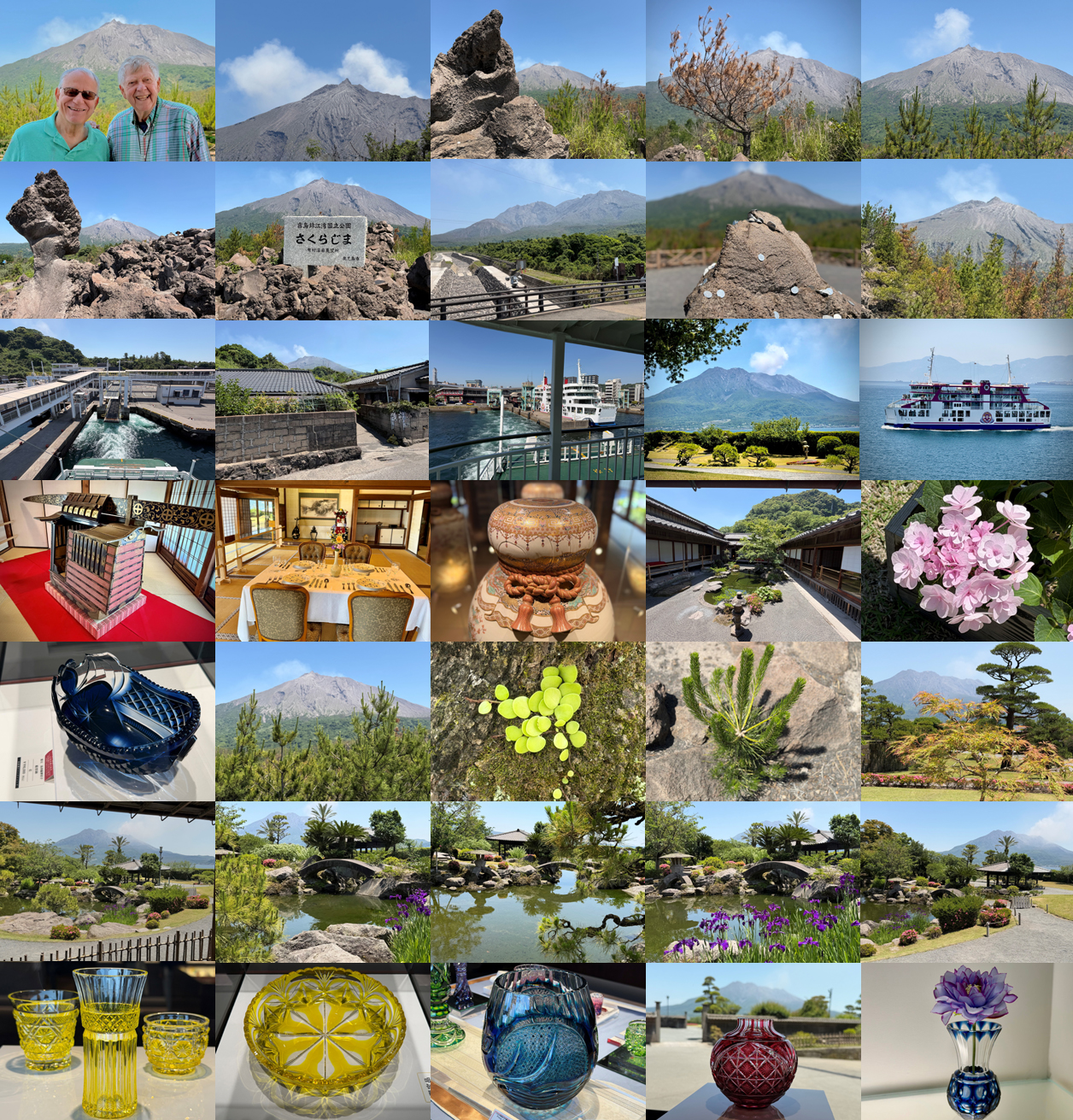
Sakurajima, (Active) Volcano Island
Both the Taisho lava field (1914) and the Showa lava fields below Sakurajima are fertile and can support Japanese black pine trees and Japanese pampas grass.
The pair of Satsuma-ware Vases are replicas of the original set presented by Shimadzu Tadayoshi, the 29th head of the Shimadzu family to Nicholas II the last Emperor of Russia on the occasion of his coronation in 1896. The originals are on display at the State Hermitage Museum. Notice the seasonal plants such as plum blossoms, bamboo, and chrysanthemums. Sengan-en was built in 1658 by the 19th head of the Shimadzu family, Mitsuhisa. The house was built at the same time as the gardens, but has been renovated a number of times over the last several hundred years. The house and gardens were loved by generation of the Shimadzu family and were used as a place to welcome dignitaries from both Japan and overseas from the late 19th century.
The 29th head of the Shimadzu family, Tadayoshi was granted the title of Prince Shimadzu and lived at Sengan-en full time after the dissolution of the feudal domains. The 30th head of the family, Tadashige moved to Tokyo in his youth, and the house was reduced to one-third its original size.
Presently the areas of the house lived in by Tadayoshi, the main reception room, the study, the secretary's office and part of the servant's quarters remain. The house is constructed of flawless Yakusugi lumber taken from trees over 1,000 years old.
Japan consists of 14,215 islands of which, 260 are inhabited.
Japan is a constitutional monarchy with the world's oldest hereditary monarchy, it blends ancient traditions with high-tech innovation, offering a unique mix of high-speed rail, profound respect for etiquette, and high life expectancy.
With a population of 126,000,000
. . . . . . here are the ethnic groups in Japan:
123,500,000 Japanese
900,000 Chinese
500,000 Korean
325,000 Filipino
300,000 Ryukyuan
265,000 Vietnamese
200,000 Ainu
92,000 Indonesian
85,000 Nepali
Kyoto ~ Japan's Capital during Edo Period
During the Edo period, (1603-1868), Kyoto transitioned from the political capital to Japan's cultural and artistic heart, thriving as one of the nation's three major cities, alongside Edo and Osaka. While the shogun resided in Edo, the Emperor remained in Kyoto, keeping it the center of tradition, craftsmanship, and refined art, featuring a flourishing merchant culture. Kyoto was the imperial capital and residence of the Emperor of Japan for over 1,000 years, specifically from 794 to 1868. Known then as Heian-kyo, it served as the enter of political, cultural, and economic life before the Meiji Restoration.